Event
TUAT Members Only 【GIR Seminar】 Dr. Mario A. Cypko / Hahn-Schikard (Germany) / University of Freiburg (Germany)
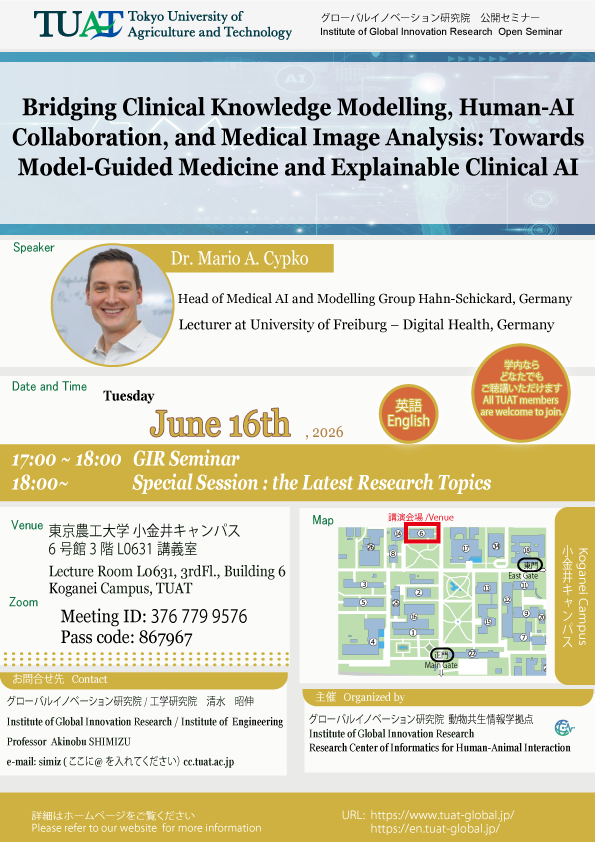
| Date | 2026.6.16 (17:00 - 18:00) |
|---|---|
| Venue |
Lecture Room L0631, 3rd Fl., Building 6, Koganei Campus, TUAT Meeting ID:376 779 9576 Passcode:867967 |
| Speaker | Dr. Mario A. Cypko |
| Affiliation | Hahn-Schickard / University of Freiburg (Germay) |
| Title | "Bridging Clinical Knowledge Modelling, Human-AI Collaboration, and Medical Image Analysis: Towards Model-Guided Medicine and Explainable Clinical AI" <Abstract> Clinical decision making increasingly involves the use, evaluation, and integration of multiple model classes, including anatomical planning and simulation models, probabilistic decision models, workflow models, imaging AI, and emerging large language and multimodal foundation models. Yet these models are rarely treated as durable scientific objects. Many are created for specific tasks, evaluated through isolated performance metrics, and disseminated without explicit documentation of their assumptions, intended use, clinical scope, validity boundaries, responsibility, version history, or lifecycle status. This talk argues for a transition towards model-guided medicine, in which clinical models become governed, inspectable, human-interpretable, and lifecycle-aware artefacts for decision making. Clinical modelling cannot be reduced to prediction. Medical knowledge also requires mathematically meaningful, transparent, and human-readable representations that can be reviewed, maintained, updated, and linked to clinical purpose, context, and action. Knowledge-based models may serve as decision, prediction, or simulation systems when their purpose, assumptions, and validity context are explicit enough for clinical review. They may also bridge clinical knowledge and data-driven AI, particularly for time-series data, medical imaging, and multimodal patient representations. We illustrate this perspective using preliminary work on causal network-induced multimodal embedding models. Here, embeddings are not presented as transparent knowledge models, but as partially opaque representations whose clinical use requires anchoring in inspectable knowledge structures, validity assumptions, and human-AI interaction mechanisms. We conclude that medicine needs a dedicated Medical Model Science alongside Data Science and Informatics. It establishes clinical models as an independent epistemic and operational layer concerned with their creation, validation, comparison, maintenance, governance, and retirement. Without such a layer, uncontrolled generation and dissemination of model variants, AI-generated claims, and hallucinated pseudo-knowledge may compromise the distinction between validated clinical knowledge and artefacts that merely appear plausible. The challenge is not only to build more clinical AI, but to determine which models are justified to guide medicine. |
| Language | English |
| Intended for | All TUAT members are welcome to join |
| Organized by | Institute of Global Innovation Research "Research Center of Informatics for Human-Animal Interaction" |
| Contact | Institute of Global Innovation Research, Institute of Engineering Prof. Akinobu Shimizu Email: simiz(at)cc.tuat.ac.jp |
| Remarks | This seminar will be held both face-to-face and online concurrently. |
このページの上部へ