Event
【GIR Open Seminar】 Dr. David Mendoza-Cózatl/ Dr. Norma Castro-Guerrero/ University of Missouri (U.S.A.)
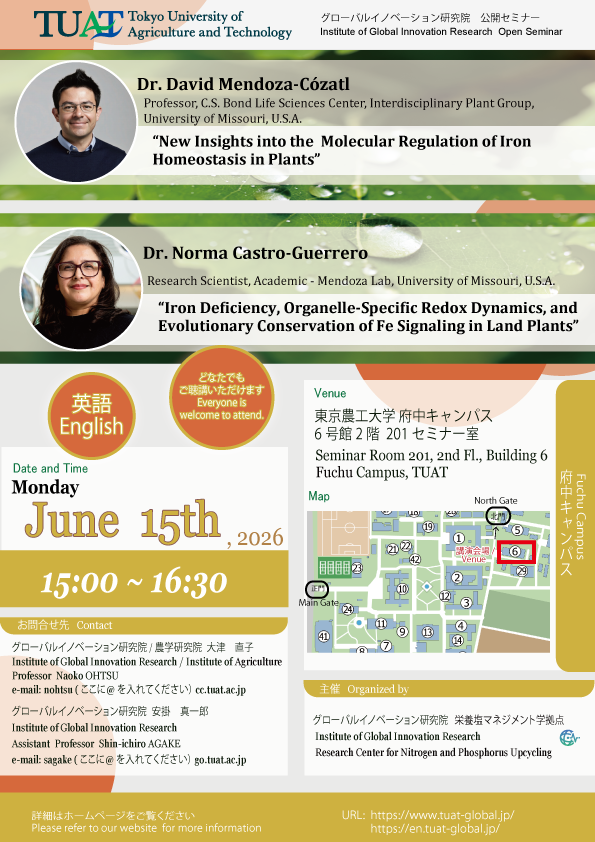
| Date | 2026.6.15 (15:00 - 16:30) |
|---|---|
| Venue | |
| Speaker | Dr. David Mendoza-Cózatl Dr. Norma Castro-Guerrero University of Missouri (U.S.A.) |
| Title | ◆Dr. David Mendoza-Cózatl "New Insights into the Molecular Regulation of Iron Homeostasis in Plants" <Abstract> If given enough water and light, plants can assimilate all the nutrients they need in elemental or inorganic forms (e.g. Fe2+, SO42-) and synthesize all the molecules required to complete their life cycle. Biochemically speaking, this is a feat that only few organisms on Earth can achieve. Plants, however, also need to regulate the uptake of nutrients to prevent an overload. This is particularly critical for reactive elements such as iron (Fe), which is essential for respiration and photosynthesis but in excess, promotes the formation of reactive oxygen species (ROS), which may damage proteins, membranes, and DNA. Sulfur metabolism in plants is tightly associated with Fe homeostasis; this may not be surprising considering that iron-sulfur (Fe-S) clusters are at the core of respiratory and photosynthetic complexes. However, how these two pathways communicate with each other at the molecular level is unknown. We recently discovered that the primary site of Fe sensing in Arabidopsis is the leaf vasculature of source leaves, which prompted us to pursue whole genome transcriptome analyses in leaves in response to Fe deficiency at relatively short periods of time (0-15 hr). Perhaps one of the most exciting results of this time-series analysis, was the discovery that genes associated with sulfur metabolism, including transport and reduction are tightly correlated with Fe deficiency responses. Of particular interest to us was AtNEET, a 2Fe-2S protein found to be among the fastest de-regulated genes in leaves when Fe becomes limiting. AtNEET belongs to a family of proteins with a unique structure, where 2Fe-2S clusters are coordinated by 3 Cys and 1 His. To further characterize AtNEET, we generated transgenic plants expressing a variant where the single His coordinating the Fe-S clusters was mutated to Cys, making the Fe-S clusters remarkably stable and less prone to be transferred between proteins. Interestingly, plants expressing this AtNEET variant (H89C) display severe developmental phenotypes and a constitutive Fe deficiency response. At the meeting we will discuss a model that places AtNEET at the crossroad between Fe sensing, sulfur metabolism, and redox control in plants. This talk will discuss recent progress in leaf-based iron sensing and how molecular, computational, and phenotyping approaches can help uncover mechanisms that improve crop nutrition and stress resilience. ----------------------------------------------------------------------------------------------------------------------- ◆Dr. Norma Castro-Guerrero "Iron Deficiency, Organelle-Specific Redox Dynamics, and Evolutionary Conservation of Fe Signaling in Land Plants" <Abstract> Iron (Fe) is an essential micronutrient for plants and organisms across all kingdoms of life due to its central role in electron transport, photosynthesis, respiration, DNA replication, and redox regulation. Although Fe is highly abundant in the Earth’s crust, its bioavailability is often limited leading to Fe deficiency, which negatively impacts plant growth, crop productivity, and seed nutritional quality. To cope with these limitations, plants have evolved sophisticated regulatory networks involving Fe sensing, transcriptional control of Fe deficiency responsive genes, post-translational regulation of transporters, and coordinated uptake and redistribution mechanisms between tissues. In addition, systemic signaling pathways coordinating shoot-to-root communication and Fe allocation are increasingly recognized as key components of Fe homeostasis, although many aspects of these mechanisms remain poorly understood. Because Fe is required for the proper function of chloroplasts and mitochondria, Fe deficiency strongly affects organelle-specific redox homeostasis by disrupting electron transport processes and promoting the accumulation of reactive oxygen species (ROS). Understanding how plants regulate redox balance under Fe limitation is therefore critical to decipher the integration of nutrient sensing, metabolic adaptation, and oxidative stress responses. In this work, we explore Fe deficiency responses by integrating analyses of ROS dynamics, photosynthetic performance, and differential gene expression in Arabidospsis thaliana. Additionally, we investigate these mechanisms in Marchantia polymorpha to provide an evolutionary perspective on the conservation and diversification of Fe deficiency signaling and redox regulation across land plants. |
| Language | English |
| Intended for | Everyone is welcome to join |
| Organized by | Institute of Global Innovation Research, Research Center for Nitrogen and Phosphorus Upcycling |
| Contact | Institute of Global Innovation Research/ Institute of Agriculture Professor Naoko OHTSU e-mail: nohtsu(at)cc.tuat.ac.jp Institute of Global Innovation Research Assistant Professor Shin-ichiro AGAKE e-mail: sagake(at)go.tuat.ac.jp |
| Remarks | This Seminar will only be held face-to-face. |
このページの上部へ