Event
【GIR Open Seminar】 Dr. Ching-Yao Chen / National Yang Ming Chiao Tung University (Taiwan)
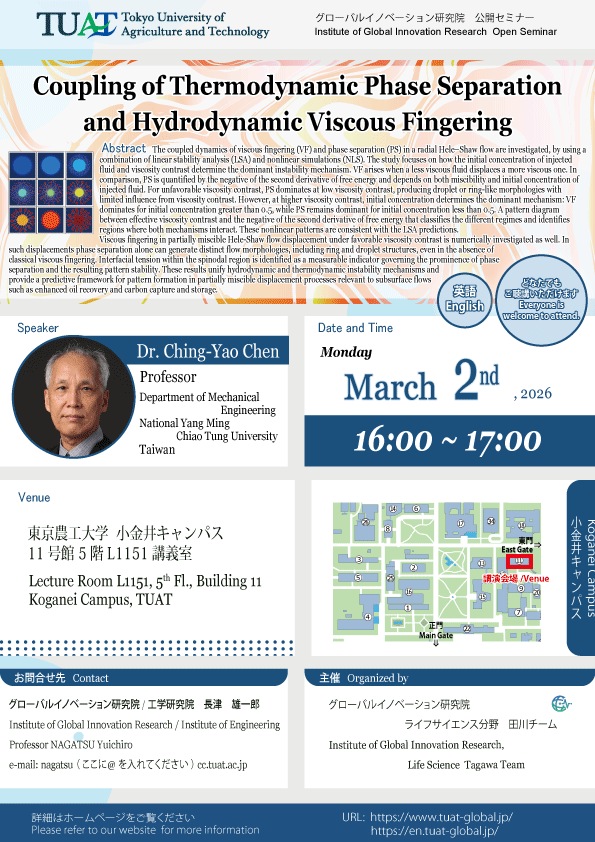
| Date | 2026.3.2 (16:00 - 17:00) |
|---|---|
| Venue |
Lecture Room L1151, 5th Fl., Building 11, Koganei Campus, TUAT |
| Speaker | Dr. Ching-Yao Chen |
| Affiliation | National Yang Ming Chiao Tung University (Taiwan) |
| Title | "Coupling of Thermodynamic Phase Separation and Hydrodynamic Viscous Fingering" <Abstract> The coupled dynamics of viscous fingering (VF) and phase separation (PS) in a radial Hele–Shaw flow are investigated, by using a combination of linear stability analysis (LSA) and nonlinear simulations (NLS). The study focuses on how the initial concentration of injected fluid and viscosity contrast determine the dominant instability mechanism. VF arises when a less viscous fluid displaces a more viscous one. In comparison, PS is quantified by the negative of the second derivative of free energy and depends on both miscibility and initial concentration of injected fluid. For unfavorable viscosity contrast, PS dominates at low viscosity contrast, producing droplet or ring-like morphologies with limited influence from viscosity contrast. However, at higher viscosity contrast, initial concentration determines the dominant mechanism: VF dominates for initial concentration greater than 0.5, while PS remains dominant for initial concentration less than 0.5. A pattern diagram between effective viscosity contrast and the negative of the second derivative of free energy that classifies the different regimes and identifies regions where both mechanisms interact. These nonlinear patterns are consistent with the LSA predictions. Viscous fingering in partially miscible Hele-Shaw flow displacement under favorable viscosity contrast is numerically investigated as well. In such displacements phase separation alone can generate distinct flow morphologies, including ring and droplet structures, even in the absence of classical viscous fingering. Interfacial tension within the spinodal region is identified as a measurable indicator governing the prominence of phase separation and the resulting pattern stability. These results unify hydrodynamic and thermodynamic instability mechanisms and provide a predictive framework for pattern formation in partially miscible displacement processes relevant to subsurface flows such as enhanced oil recovery and carbon capture and storage. |
| Language | English |
| Intended for | Everyone is welcome to join |
| Organized by | Institute of Global Innovation Research "LIFE SCIENCE" Tagawa Team |
| Contact | Institute of Global Innovation Research, Institute of Engineering Prof. Yuichiro Nagatsu e-mail: nagatsu(at)cc.tuat.ac.jp |
このページの上部へ